味噌汁
As part and parcel of Japanese cuisine as sushi and rice, miso soup (misoshiru) is a true gourmet's delight. Made from a fish-based stock (dashi), miso soup is not suitable for vegetarians but for demi-veggies miso soup is usually a meat-free zone.
Softened miso paste (made from soy beans) is added to the dashi stock to form the base of the soup and various ingredients are added such as cubes of tofu, Chinese cabbage, daikon radish, wakame seaweed, sliced negi onions and mushrooms.
There is considerable regional as well as seasonal variety in the type of miso used producing different flavors between Kansai and Kanto miso soup.
Instant miso soup comes in single-serving sachets containing dried wakame and tofu with miso paste that dissolves with the addition of hot water and can be bought in any supermarket.
Miso soup is usually served in red and black lacquer bowls.
© JapanVisitor.com
Yahoo Japan Auction Service
Japanese Friends
Tokyo Apartments Search
Japan Job Search
Rough Guide To Japan
Tags
Japan cuisine
Miso
Miso soup
Soy
Japanese Food
Showing posts with label Japanese food. Show all posts
Wednesday, October 27, 2010
Thursday, October 7, 2010
Japanese Pickles
つけもの (漬物)
Japanese pickles known as tsuke-mono are one of my favorite Japanese foods and completely vegetarian to boot.
Japanese pickles are not usually pickled in vinegar but in salt, soy sauce or sometimes sake lees.
Tsukemono are eaten as a side dish with rice at a traditional Japanese meal - either breakfast or dinner but also turn up with Japanese curries.
Favorite vegetables that are pickled in Japan include daikon radish, turnip, umeboshi, cucumber, Chinese cabbage, shibazuke (rape blossoms), eggplant and ginger.
Kyoto tsukemono (kyotsukemono) is particularly well known and many Japanese tourists take home pickles from any trip to the ancient capital. The wooden pickling barrels can be seen in the area near Kamigamo Shrine, which has a long tradition of tsukemono production.
Full of vitamin C and fiber, though heavy on the salt, tsukemono are a healthy addition to your diet.
© JapanVisitor.com
Yahoo Japan Auction Service
Japanese Friends
Tokyo Apartments Search
Japan Job Search
Rough Guide To Japan
Tags
tsukemono
pickles
Kyoto
Japanese food
Japanese pickles known as tsuke-mono are one of my favorite Japanese foods and completely vegetarian to boot.
Japanese pickles are not usually pickled in vinegar but in salt, soy sauce or sometimes sake lees.
Tsukemono are eaten as a side dish with rice at a traditional Japanese meal - either breakfast or dinner but also turn up with Japanese curries.
Favorite vegetables that are pickled in Japan include daikon radish, turnip, umeboshi, cucumber, Chinese cabbage, shibazuke (rape blossoms), eggplant and ginger.
Kyoto tsukemono (kyotsukemono) is particularly well known and many Japanese tourists take home pickles from any trip to the ancient capital. The wooden pickling barrels can be seen in the area near Kamigamo Shrine, which has a long tradition of tsukemono production.
Full of vitamin C and fiber, though heavy on the salt, tsukemono are a healthy addition to your diet.
© JapanVisitor.com
Yahoo Japan Auction Service
Japanese Friends
Tokyo Apartments Search
Japan Job Search
Rough Guide To Japan
Tags
tsukemono
pickles
Kyoto
Japanese food
Wednesday, October 6, 2010
Chawan Mushi
茶碗蒸し
Chawan Mushi lit. "tea cup steamed" is an egg custard dish popular as part of a full course Japanese meal.
Eaten with a spoon from a ceramic bowl usually with a lid, chawan mushi is flavored with a mix of dashi, mirin and soy sauce and usually contains chicken, shrimp, shiitake or shimeji mushrooms, mitsuba and kamaboko, so the dish is not suitable for vegetarians.
In the pictures above, the kamaboko (fish paste) is colored and shaped as a maple leaf.
© JapanVisitor.com
Yahoo Japan Auction Service
Japanese Friends
Tokyo Apartments Search
Japan Job Search
Rough Guide To Japan
Tags
Japan Cuisine
Chawan Mushi
Eggs
Japanese Food
Chawan Mushi lit. "tea cup steamed" is an egg custard dish popular as part of a full course Japanese meal.
Eaten with a spoon from a ceramic bowl usually with a lid, chawan mushi is flavored with a mix of dashi, mirin and soy sauce and usually contains chicken, shrimp, shiitake or shimeji mushrooms, mitsuba and kamaboko, so the dish is not suitable for vegetarians.
In the pictures above, the kamaboko (fish paste) is colored and shaped as a maple leaf.
© JapanVisitor.com
Yahoo Japan Auction Service
Japanese Friends
Tokyo Apartments Search
Japan Job Search
Rough Guide To Japan
Tags
Japan Cuisine
Chawan Mushi
Eggs
Japanese Food
Thursday, September 23, 2010
Hiyashi Chuka Japanese Cold Noodles
冷やし中華
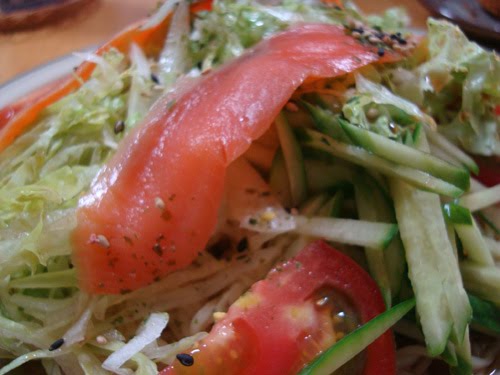
Hiyashi Chuka, Chinese-style Japanese cold noodles, is a summer staple designed to beat the heat.
The dish, basically a ramen noodle salad, is made with lots of toppings including sliced cucumber, smoked salmon, sliced omelette (tamagoyaki), chicken, tomatoes and beni shoga (pickled red ginger).
Vegetarians and demi-vegetarians can replaced the meat, eggs and fish with vegetarian alternatives including yuba or dried bean curd, bean sprouts and grated carrots. Add mayonnaise for the kids.
After boiling the noodles, drain and add the toppings and the tare sauce usually a soy and sesame mix that can be bought in supermarkets or made at home.
© JapanVisitor.com
Yahoo Japan Auction Service
Japanese Friends
Tokyo Apartments Search
Japan Job Search
Rough Guide To Japan
Tags
Ramen
Hiyashi Chuka
Cold Noodles
Japanese Food
Hiyashi Chuka, Chinese-style Japanese cold noodles, is a summer staple designed to beat the heat.
The dish, basically a ramen noodle salad, is made with lots of toppings including sliced cucumber, smoked salmon, sliced omelette (tamagoyaki), chicken, tomatoes and beni shoga (pickled red ginger).
Vegetarians and demi-vegetarians can replaced the meat, eggs and fish with vegetarian alternatives including yuba or dried bean curd, bean sprouts and grated carrots. Add mayonnaise for the kids.
After boiling the noodles, drain and add the toppings and the tare sauce usually a soy and sesame mix that can be bought in supermarkets or made at home.
© JapanVisitor.com
Yahoo Japan Auction Service
Japanese Friends
Tokyo Apartments Search
Japan Job Search
Rough Guide To Japan
Tags
Ramen
Hiyashi Chuka
Cold Noodles
Japanese Food
Tuesday, September 14, 2010
Natto
納豆
One standard question that many foreigners in Japan are asked is: "Can you eat natto?"
The strong smell and slimy constituency of natto - fermented soybeans - means that even many Japanese are put off this much-maligned, healthy, gooey and 100% vegetarian delicacy.
Natto is usually served with a touch of karashi mustard and a drizzle of soy sauce and eaten as an accompaniment to rice whether at breakfast or dinner. A little bit of sake poured on the natto as a condiment can also add to the flavor, I've found.
Mass produced natto sold in supermarkets usually comes in a 50g polystyrene pack with little sachets of mustard and soy sauce.
The health benefits of eating natto are many and legendary and include lowering cholesterol, preventing cancer and strokes to helping fight obesity.
So in answer to the question, "Can you eat natto?"
Yes, I'm lovin' it.
© JapanVisitor.com
Yahoo Japan Auction Service
Japanese Friends
Tokyo Apartments Search
Japan Job Search
Rough Guide To Japan
Tags
Japan Cuisine
Natto
Soy
Soybeans
Japanese Food
One standard question that many foreigners in Japan are asked is: "Can you eat natto?"
The strong smell and slimy constituency of natto - fermented soybeans - means that even many Japanese are put off this much-maligned, healthy, gooey and 100% vegetarian delicacy.
Natto is usually served with a touch of karashi mustard and a drizzle of soy sauce and eaten as an accompaniment to rice whether at breakfast or dinner. A little bit of sake poured on the natto as a condiment can also add to the flavor, I've found.
Mass produced natto sold in supermarkets usually comes in a 50g polystyrene pack with little sachets of mustard and soy sauce.
The health benefits of eating natto are many and legendary and include lowering cholesterol, preventing cancer and strokes to helping fight obesity.
So in answer to the question, "Can you eat natto?"
Yes, I'm lovin' it.
© JapanVisitor.com
Yahoo Japan Auction Service
Japanese Friends
Tokyo Apartments Search
Japan Job Search
Rough Guide To Japan
Tags
Japan Cuisine
Natto
Soy
Soybeans
Japanese Food
Monday, September 6, 2010
Coco Ichibanya
カレーハウスCoCo壱番屋
Curry House Coco Ichibanya began life in Nishi Biwajima in Nagoya in 1978 and now has over 1200 restaurants spread throughout all 47 prefectures in Japan as well as overseas stores in China, Hong Kong, South Korea, Taiwan, Thailand and Hawaii.
The company specializes in a pork cutlet curry with a thick pork-based sauce but also has a bewildering number of other dishes including aubergine curry, beef curry, chicken curry, cuttlefish curry, natto curry, shrimp curry, tofu curry, vegetable curry etc etc. All the curries come with the pork-rich stew so this is not a place for vegetarians. Customize your curry by choosing the level of spiciness and the amount of rice you require.
Diners can order from an English menu and a variety of sides dishes: salads, croquettes and pickles are also available.
Service is usually quick and polite as befits the company's motto: "Briskly, Sharply, and with a Smile."
Coco Ichibanya has offered various gimmicks to keep its loyal customers including a free curry refill if you can finish off their largest curry on the menu.
Coco Ichibanya
© JapanVisitor.com
Yahoo Japan Auction Service
Japanese Friends
Tokyo Apartments Search
Japan Job Search
Rough Guide To Japan
Tags
Coco Ichibanya
Curry
Kyoto
Nagoya
Japanese Food
Curry House Coco Ichibanya began life in Nishi Biwajima in Nagoya in 1978 and now has over 1200 restaurants spread throughout all 47 prefectures in Japan as well as overseas stores in China, Hong Kong, South Korea, Taiwan, Thailand and Hawaii.
The company specializes in a pork cutlet curry with a thick pork-based sauce but also has a bewildering number of other dishes including aubergine curry, beef curry, chicken curry, cuttlefish curry, natto curry, shrimp curry, tofu curry, vegetable curry etc etc. All the curries come with the pork-rich stew so this is not a place for vegetarians. Customize your curry by choosing the level of spiciness and the amount of rice you require.
Diners can order from an English menu and a variety of sides dishes: salads, croquettes and pickles are also available.
Service is usually quick and polite as befits the company's motto: "Briskly, Sharply, and with a Smile."
Coco Ichibanya has offered various gimmicks to keep its loyal customers including a free curry refill if you can finish off their largest curry on the menu.
Coco Ichibanya
© JapanVisitor.com
Yahoo Japan Auction Service
Japanese Friends
Tokyo Apartments Search
Japan Job Search
Rough Guide To Japan
Tags
Coco Ichibanya
Curry
Kyoto
Nagoya
Japanese Food
Friday, August 13, 2010
Osho Gyoza
餃子の王将
Gyoza no Osho is a cheap and cheerful Chinese-style Japanese fast food restaurant chain specializing in such classic Chinese dishes as fried dumplings (gyoza), noodles (ramen) and sweet and sour pork (subutta).
You may well be served by someone wearing white Wellington boots, but prices are cheap so never mind the MSG, tuck in!
Osho began life in 1967 in Kyoto and now the company operates over 500 restaurants in 29 of Japan's 47 prefectures, even managing to weather the seemingly-endless slump in Japan's economy. Osho has even re-exported Chinese food to China with the opening of its three eateries in Dalian, north eastern China.
Osho restaurants normally open between 11am and 11pm or even later.
Gyoza no Osho
© JapanVisitor.com
Yahoo Japan Auction Service
Japanese Friends
Tokyo Apartments Search
Japan Job Search
Rough Guide To Japan
Tags
Japan restaurants
gyoza
Japanese Food
Gyoza no Osho is a cheap and cheerful Chinese-style Japanese fast food restaurant chain specializing in such classic Chinese dishes as fried dumplings (gyoza), noodles (ramen) and sweet and sour pork (subutta).
You may well be served by someone wearing white Wellington boots, but prices are cheap so never mind the MSG, tuck in!
Osho began life in 1967 in Kyoto and now the company operates over 500 restaurants in 29 of Japan's 47 prefectures, even managing to weather the seemingly-endless slump in Japan's economy. Osho has even re-exported Chinese food to China with the opening of its three eateries in Dalian, north eastern China.
Osho restaurants normally open between 11am and 11pm or even later.
Gyoza no Osho
© JapanVisitor.com
Yahoo Japan Auction Service
Japanese Friends
Tokyo Apartments Search
Japan Job Search
Rough Guide To Japan
Tags
Japan restaurants
gyoza
Japanese Food
Sunday, August 8, 2010
Conveyor Sushi Kaitenzushi
回転寿司
Conveyor belt sushi (kaiten-zushi) is a fixture of the Japanese fast food scene and kaiten-zushi restaurants can be found in most Japanese towns and cities. To cut down on costs, customers choose their sushi from the conveyor belt as it passes their table or counter or they can order from a touch-screen display.
Soy sauce, ginger, free green tea and disposable chopsticks (waribashi) are found at your seat and the bill is calculated from the number and color of the empty plates of sushi stacked in front of you.
Conveyor belt sushi was the brainchild of Yoshiaki Shiraishi (1914-2001) who got the idea from beer bottles on a conveyor belt in a brewery and utilized it to solve the staffing problems in his sushi restaurant, Genroku in Higashiosaka.
Kaiten-zushi restaurants can now be found not just in Japan but worldwide.
© JapanVisitor.com
Yahoo Japan Auction Service
Japanese Friends
Japan Job Search
Rough Guide To Japan
Tags
sushi
kaitenzushi
Japanese Food
Conveyor belt sushi (kaiten-zushi) is a fixture of the Japanese fast food scene and kaiten-zushi restaurants can be found in most Japanese towns and cities. To cut down on costs, customers choose their sushi from the conveyor belt as it passes their table or counter or they can order from a touch-screen display.
Soy sauce, ginger, free green tea and disposable chopsticks (waribashi) are found at your seat and the bill is calculated from the number and color of the empty plates of sushi stacked in front of you.
Conveyor belt sushi was the brainchild of Yoshiaki Shiraishi (1914-2001) who got the idea from beer bottles on a conveyor belt in a brewery and utilized it to solve the staffing problems in his sushi restaurant, Genroku in Higashiosaka.
Kaiten-zushi restaurants can now be found not just in Japan but worldwide.
© JapanVisitor.com
Yahoo Japan Auction Service
Japanese Friends
Japan Job Search
Rough Guide To Japan
Tags
sushi
kaitenzushi
Japanese Food
Subscribe to:
Posts (Atom)