東京モノレール
The Tokyo Monorail connects Hamamatsucho Station to Haneda Airport.
Haneda Airport now has international flights to Asia, America and Europe after the opening of the new international terminal and the Haneda Airport International Terminal Station on October 21, 2010.
Built in 1964 as part of the Tokyo Olympics development, the cars of the Tokyo Monorail still have that 60s feel to them.
From Haneda Airport International Terminal Station the Tokyo Monoral links to Shin-Seibijō (新整備場), Haneda Airport Terminal 1 (羽田空港第1ビル) and Haneda Airport Terminal 2 (羽田空港第2ビル).
The Haneda Express takes 19 minutes to Haneda Airport Terminal 2 and just 13 minutes to Haneda Airport International Terminal Station from Hamamatsucho Station on the Yamanote Line. Local trains take 18 minutes to Haneda Airport International Terminal Station and Rapid trains 15 minutes.
From Monorail Hamamatsu the stations on the Tokyo Monorail are Tennozu Isle, Oi Keibajo-mae, Ryutsu Center, Showajima, Seibijo, Tenkubashi, Haneda Airport International Terminal Station, Shin Seibijo, Haneda Airport Terminal 1 and Haneda Airport Terminal 2.
Suica and a number of other IC cards can be used on the Tokyo Monorail including: Icoca, Kitaca, Pasmo, Sugoca, Toica and Nimoca.
The standard fare from Monorail Hamamatsu to Haneda Airport International Terminal Station is 470 yen.
Tokyo Monorail
© JapanVisitor.com
Like this blog? Sign up for the JapanVisitor newsletter
Yahoo Japan Auction Service
Japanese Friends
Tokyo Apartments Search
Japan Job Search
Rough Guide To Japan
Tags
Tokyo Monorail
Tokyo
Haneda Airport
Tokyo Travel
Japanese Airports
Showing posts with label Tokyo. Show all posts
Friday, December 10, 2010
Wednesday, December 8, 2010
Ginkgo
イチョウ
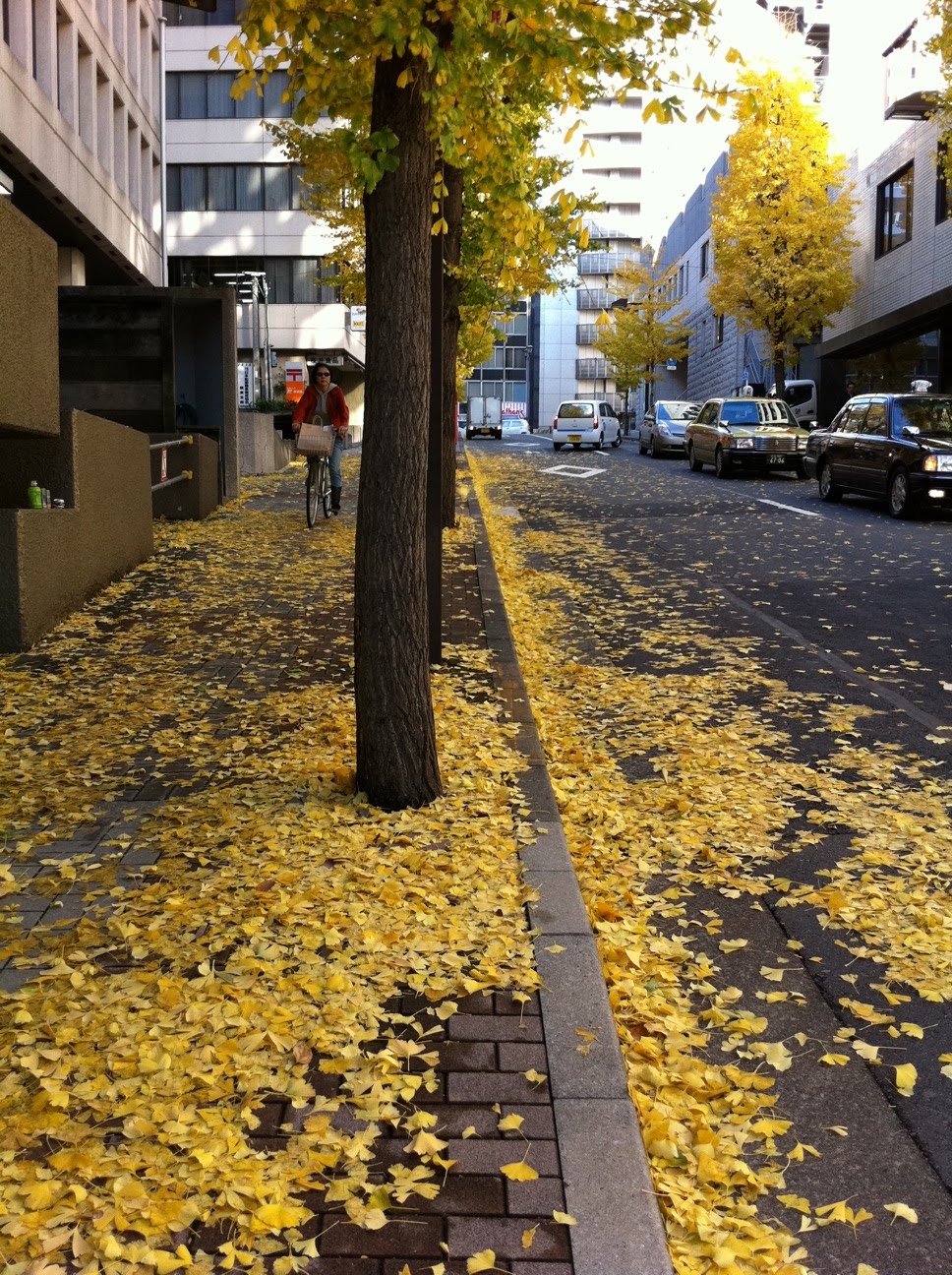
Tokyo, among numerous other Japanese cities, is full of gingko trees (Ginkgo biloba), and autumn in Tokyo is characterized by the vivid yellow of the gingko's fallen leaves, and the distinctive smell (AKA the stench) of its seeds.
© JapanVisitor.com
Like this blog? Sign up for the JapanVisitor newsletter
Yahoo Japan Auction Service
Japanese Friends
Tokyo Apartments Search
Japan Job Search
Rough Guide To Japan
Tags
Japan
Tokyo
ginkgo
Ginkgo leaves in Kojimachi, Tokyo
Tokyo, among numerous other Japanese cities, is full of gingko trees (Ginkgo biloba), and autumn in Tokyo is characterized by the vivid yellow of the gingko's fallen leaves, and the distinctive smell (AKA the stench) of its seeds.
Gingko leaves stuck to a wall
The ginkgo is a living fossil, and has no closely related species. Its leaves and nuts are held to have various medicinal properties, some of them ratified by modern science, but many claims having been found to be imaginary.
They lend great character to Japanese streets in fall, as seen by these photos taken last week.
Gingko leaves in Asakusabashi, Tokyo
© JapanVisitor.com
Like this blog? Sign up for the JapanVisitor newsletter
Yahoo Japan Auction Service
Japanese Friends
Tokyo Apartments Search
Japan Job Search
Rough Guide To Japan
Tags
Japan
Tokyo
ginkgo
Sunday, November 14, 2010
APEC hits Tokyo traffic
The 18th APEC Economic Leaders’ Meeting took place in Yokohama on 13 and 14 November - just finishing last night. While attempts were being made to kick start the long-stalled Doha Development Round talks, and Prime Minister Kan reasserted the Japaneseness of the Senkaku/Diaoyu Islands, and President Obama was seeking freer trade with Asian countries, the police in Tokyo were taking no risks and restricting traffic around key areas of the meeting and the leaders' accommodation.
The result this weekend was unusually severe traffic congestion in certain parts of Tokyo, a fact that was carefully planned for and which announcements were made continually over Saturday and Sunday.
The above photo was taken on Edo-dori Avenue in Tokyo's Taito ward (one stop east of Akihabara). It says "APEC: until November 14, restrictions are in place on metropolitan freeways."
© JapanVisitor.com
Yahoo Japan Auction Service
Japanese Friends
Tokyo Apartments Search
Japan Job Search
Rough Guide To Japan
Tags
Japan
Tokyo
APEC
traffic
Monday, November 8, 2010
Suitengu Shrine
水天宮
Suitengu Shrine is a Shinto shrine in Tokyo famous for being where expectant mothers go to pray for the safe delivery of their child.
Interestingly, this shrine’s roots are in Fukuoka prefecture, but it was moved to its present site in Tokyo’s Nihonbashi-kakigaracho district (in Chuo ward) in 1871. This followed a process known as bunrei, literally, “splitting of the spirit,” whereby the spirit worshiped at the original shrine was “split” for simultaneous worship at another shrine.
The god enshrined there, Ame-no-minaka-nushi-no-kami, is not a god that was closely associated with daily life, but was more of a creator-type character, and for this reason worship of it was not usual until about 700 years ago.
The present shrine building dates from 1967, and is on the upper of two stories, taking full advantage of the prime Tokyo land it occupies by housing commercial premises on the ground floor.
It hosts numerous events throughout the year. The one pictured here is typical, with vendors selling food and amulets, and priests performing rituals over the mothers gathered there.
Suitengu Shrine features some interesting statuary, from the ornate, fierce lions at the main entrance, to the bronze bitch looking after her puppy, to the cute kappa – a legendary river denizen – also nursing its child.
Hours
7am-5pm
Access
Suitengu-mae Station, Hanzomon Subway Line, Exit 5
Google Map of Suitengu
© JapanVisitor.com
Yahoo Japan Auction Service
Japanese Friends
Tokyo Apartments Search
Japan Job Search
Rough Guide To Japan
Tags
Japan
Tokyo
Suitengu Shrine
maternity
shinto
Suitengu Shrine is a Shinto shrine in Tokyo famous for being where expectant mothers go to pray for the safe delivery of their child.
Interestingly, this shrine’s roots are in Fukuoka prefecture, but it was moved to its present site in Tokyo’s Nihonbashi-kakigaracho district (in Chuo ward) in 1871. This followed a process known as bunrei, literally, “splitting of the spirit,” whereby the spirit worshiped at the original shrine was “split” for simultaneous worship at another shrine.
The god enshrined there, Ame-no-minaka-nushi-no-kami, is not a god that was closely associated with daily life, but was more of a creator-type character, and for this reason worship of it was not usual until about 700 years ago.
The present shrine building dates from 1967, and is on the upper of two stories, taking full advantage of the prime Tokyo land it occupies by housing commercial premises on the ground floor.
It hosts numerous events throughout the year. The one pictured here is typical, with vendors selling food and amulets, and priests performing rituals over the mothers gathered there.
Suitengu Shrine features some interesting statuary, from the ornate, fierce lions at the main entrance, to the bronze bitch looking after her puppy, to the cute kappa – a legendary river denizen – also nursing its child.
Hours
7am-5pm
Access
Suitengu-mae Station, Hanzomon Subway Line, Exit 5
Google Map of Suitengu
© JapanVisitor.com
Yahoo Japan Auction Service
Japanese Friends
Tokyo Apartments Search
Japan Job Search
Rough Guide To Japan
Tags
Japan
Tokyo
Suitengu Shrine
maternity
shinto
Wednesday, November 3, 2010
SOAS Alumni Meeting in Tokyo
London University’s School of Oriental and African Studies is one of the world’s leading centers of learning and research in things Asian and African. It has had an alumni association in Japan since the mid-90s. Having graduated with a masters in Japanese history from SOAS a decade and a half ago, I am on the alumni mailing list, and now living in Tokyo as I do, can easily attend its meetings.
Tuesday night was my first time to attend a SOAS alumni meeting. It was held at the British Embassy, just across from the Imperial Palace - only 5 minutes on my bicycle from the office in Kojimachi. It is located on what, next to the Imperial Palace itself, is historically Tokyo’s most prime real estate, having been the locale for the direct retainers of the Shogun, the gokenin and hatamoto, in the Edo era. The Shogun’s castle was the present site of the Palace.
It was only a few minutes past 6, but dark already. Cycling along the quaint old path in front of the embassy - rough paving stones flanked with a margin of a dirt track - I ask a patrolling policeman where I could park my bike.
Japanese police are often fairly genial - they must get bored and lonely - and he genially told me to ask the embassy security staff at the gate when I went in. The thin sheet of ice that the security guard I approached initially put up melted almost instantly when I told him my business and produced the crumpled e-mailed invitation that I’d printed out as required.
I told him my surname, he confirmed my first name, I showed him my alien registration card (or was it my driver’s license?), and he ticked my name off on his list. I was able to take my bike inside, and was escorted halfway to the bike stands and given directions where to go after that.
It had been a brilliantly sunny day, the first in a long time it seemed, and the night sky was as clear and starry as it gets for Tokyo. It looked especially picturesque framed by the dark Doric lines of the main embassy building, built in 1930.
I paid my 4,000 yen (had to be exact change) at the door, and got an "I Love SOAS" badge (see pic above - taken in the mirror, so reads funny) and an "I Love SOAS" business card holder - both in beautiful SOAS purple. The get together was well attended, with about 40 to 50 people filling the function room, and had a good mix of male and female, Japanese and foreigners, recent graduates and old graduates.
The opening address by the Director of SOAS, Professor Paul Webley, was partway through when I entered. He spoke of how successfully SOAS is doing in spite of the 40% cut to tertiary education spending by the British government (not as drastic as it sounds since SOAS relies on the state for only 25% of its funding).
The 4000 yen was worth it, especially since, we were told, it will not be required for future get togethers. Solicitous staff were constantly circulating, proactively refilling drinks and proffering mouthful after mouthful of everything from tiny egg sandwiches, to tandoori chicken pieces on toothpicks, to all sorts of great tasting sushi.
Having been out of the SOAS milieu for so long it was pleasant to relive it, however remotely and dilutedly, and talk to new people from different SOAS periods and fields of study.
I met teachers, students, administrators, an anthropology researcher. Fittingly the person most lacking in social nerviness was Professor Paul Webley who shone energy and joviality and helped keep the evening bubbling.
Five conversations was about my limit before my smile started to feel stuck on; any more and my face-and-name memory would have given out (may I blame two solid years of mid- and post-seminar breaks downstairs at the SOAS cafe all those years ago?) so I shook hands goodbye and made my way with my four or five meishi back out into the night.
© JapanVisitor.com
Yahoo Japan Auction Service
Japanese Friends
Tokyo Apartments Search
Japan Job Search
Rough Guide To Japan
Tags
Japan
Tokyo
SOAS
alumni
British Embassy
Monday, October 25, 2010
Goldengai By Night
新宿ゴールデン街
Tokyo's Goldengai drinking area is located a short walk from Shinjuku Station's east exit.
Saved from destruction by the devotion of its committed patrons, Goldengai retains the atmosphere and architecture of 1960s Tokyo.
A drinking haunt of artists and mavericks, author and fanatic Yukio Mishima is known to have socialized here.
Quirky, odd, ramshackled, bohemian and good fun. Enjoy these photographs of a Tokyo institution.
© Guillaume Marcotte & JapanVisitor.com
Yahoo Japan Auction Service
Book a Japanese Hotel with Bookings
Japanese Friends
Japan Job Search
Tokyo Map
Tags
Goldengai Tokyo Kabukicho
Tokyo's Goldengai drinking area is located a short walk from Shinjuku Station's east exit.
Saved from destruction by the devotion of its committed patrons, Goldengai retains the atmosphere and architecture of 1960s Tokyo.
A drinking haunt of artists and mavericks, author and fanatic Yukio Mishima is known to have socialized here.
Quirky, odd, ramshackled, bohemian and good fun. Enjoy these photographs of a Tokyo institution.
© Guillaume Marcotte & JapanVisitor.com
Yahoo Japan Auction Service
Book a Japanese Hotel with Bookings
Japanese Friends
Japan Job Search
Tokyo Map
Tags
Goldengai Tokyo Kabukicho
Thursday, October 14, 2010
Map of Tokyo
東京の地図
Use this map of Tokyo to navigate your way around the metropolis to foreign embassies, temples, shrines, hotels, shops, metro stations and Tokyo parks and gardens.
View Tokyo Map Japan in a larger map
© JapanVisitor.com
Yahoo Japan Auction Service
Japanese Friends
Tokyo Apartments Search
Japan Job Search
Rough Guide To Japan
Tags
Japan Map
Tokyo Map
Japanese Map
Use this map of Tokyo to navigate your way around the metropolis to foreign embassies, temples, shrines, hotels, shops, metro stations and Tokyo parks and gardens.
View Tokyo Map Japan in a larger map
© JapanVisitor.com
Yahoo Japan Auction Service
Japanese Friends
Tokyo Apartments Search
Japan Job Search
Rough Guide To Japan
Tags
Japan Map
Tokyo Map
Japanese Map
Sunday, September 26, 2010
Tokyo Waterworks Historical Museum
東京都水道歴史館
The Tokyo Waterworks Historical Museum is a small, easily accessible, modern museum in Tokyo’s Bunkyo ward that presents the history of a public potable water supply in the capital.
The origins of Tokyo’s water supply go back to the year 1590 when the first Tokugawa Shogun, Ieyasu, having consolidated his authority over the nation at his stronghold in the township of Edo (now Tokyo), decreed the construction of a drinkable water supply as one of the first steps in building what became a city.
The Tokyo Waterworks Historical Museum colorfully traces this history on two spacious floors of exhibits.
Read more about the Tokyo Waterworks Historical Museum
© JapanVisitor.com
Yahoo Japan Auction Service
Japanese Friends
Tokyo Apartments Search
Japan Job Search
Rough Guide To Japan
Tags
Japan
Tokyo
Museum
Water
Japanese
The Tokyo Waterworks Historical Museum is a small, easily accessible, modern museum in Tokyo’s Bunkyo ward that presents the history of a public potable water supply in the capital.
The origins of Tokyo’s water supply go back to the year 1590 when the first Tokugawa Shogun, Ieyasu, having consolidated his authority over the nation at his stronghold in the township of Edo (now Tokyo), decreed the construction of a drinkable water supply as one of the first steps in building what became a city.
The Tokyo Waterworks Historical Museum colorfully traces this history on two spacious floors of exhibits.
Read more about the Tokyo Waterworks Historical Museum
© JapanVisitor.com
Yahoo Japan Auction Service
Japanese Friends
Tokyo Apartments Search
Japan Job Search
Rough Guide To Japan
Tags
Japan
Tokyo
Museum
Water
Japanese
Tuesday, September 21, 2010
Brazilian Festival at Yoyogi Park
ブラジル祭り2010
Japan has a very large Brazilian community, mainly second generation returnees of the Japanese immigrants who went to Brazil in the early 20th century after Japan had impoverished itself in winning the Russo-Japanese War. The boom years of the 1980s brought their children and grandchildren back to Japan, but to a culture completely different to the one they were raised in.
Nevertheless, despite the cultural divide between Japanese born here and Brazilian Japanese, the latter are permitted to stay here and are able to get permanent residency much more easily than foreigners without Japanese ancestry.
Tokyo is of course home to a large percentage of the Brazilians in Japan, and Yoyogi Park sees the Brazil Festival every year, which is no holds barred celebration of Brazilian high spirits. The rhythms are infectious, and some of the dancing is like you've never seen before.
The festival took place on the ninth of this month. It has taken 10 days or so to get in gear and produce the video. Here it is. Click, and you have no choice but to ... enjoy!
© JapanVisitor.com
Yahoo Japan Auction Service
Japanese Friends
Tokyo Apartments Search
Japan Job Search
Rough Guide To Japan
Tags
Japan
Tokyo
Brazil
festival
Yoyogi
Japan has a very large Brazilian community, mainly second generation returnees of the Japanese immigrants who went to Brazil in the early 20th century after Japan had impoverished itself in winning the Russo-Japanese War. The boom years of the 1980s brought their children and grandchildren back to Japan, but to a culture completely different to the one they were raised in.
Nevertheless, despite the cultural divide between Japanese born here and Brazilian Japanese, the latter are permitted to stay here and are able to get permanent residency much more easily than foreigners without Japanese ancestry.
Tokyo is of course home to a large percentage of the Brazilians in Japan, and Yoyogi Park sees the Brazil Festival every year, which is no holds barred celebration of Brazilian high spirits. The rhythms are infectious, and some of the dancing is like you've never seen before.
The festival took place on the ninth of this month. It has taken 10 days or so to get in gear and produce the video. Here it is. Click, and you have no choice but to ... enjoy!
© JapanVisitor.com
Yahoo Japan Auction Service
Japanese Friends
Tokyo Apartments Search
Japan Job Search
Rough Guide To Japan
Tags
Japan
Tokyo
Brazil
festival
Yoyogi
Tuesday, August 31, 2010
Kiyosumi Teien Gardens, Tokyo
Tokyo's Koto ward is, like most of the city east of Ginza, far from glam and not renowned for its overall beauty. However, it is home to the Fukagawa district which is rich in historical significance and offers some aesthetically unforgettable experiences.
One spot of particular beauty in Koto ward's Fukagawa district is the Kiyosumi Teien Gardens. These relatively small gardens date from Japan's feudal era, and were once owned by the founder of the Mitsubishi corporation. They offer a feeling of languid spaciousness beyond their mere square meterage, with their large calm pond teeming with carp, tortoises and waterfowl, their immaculately maintained lawns, the elegant tea house built out over the pond, and the stone monuments that dot it, for the visitor to stop and ponder.
See a YouTube video of Kiyosumi Teien Gardens above. And read more about Kiyosumi Teien Gardens the surrounding Fukagawa district.
© JapanVisitor.com
Yahoo Japan Auction Service
Japanese Friends
Tokyo Apartments Search
Japan Job Search
Rough Guide To Japan
Tags
Japan
Tokyo
Kiyosumi
garden
Fukagawa
One spot of particular beauty in Koto ward's Fukagawa district is the Kiyosumi Teien Gardens. These relatively small gardens date from Japan's feudal era, and were once owned by the founder of the Mitsubishi corporation. They offer a feeling of languid spaciousness beyond their mere square meterage, with their large calm pond teeming with carp, tortoises and waterfowl, their immaculately maintained lawns, the elegant tea house built out over the pond, and the stone monuments that dot it, for the visitor to stop and ponder.
See a YouTube video of Kiyosumi Teien Gardens above. And read more about Kiyosumi Teien Gardens the surrounding Fukagawa district.
© JapanVisitor.com
Yahoo Japan Auction Service
Japanese Friends
Tokyo Apartments Search
Japan Job Search
Rough Guide To Japan
Tags
Japan
Tokyo
Kiyosumi
garden
Fukagawa
Monday, August 16, 2010
Beyond the pet cemetery
ペットの仏壇

Where does Fido go when he dies? A pet cemetery? Well, just in case there is a doggy heaven, get him an altar too! This product was spotted in a Tokyo department store, and in a country that is pet-crazy, has to be one of the more way-out pet accessories on the market.
This pet altar was on sale in the Buddhist accoutrement section of the department store, along with the sutra books, candles, incense, prayer beads, and small altars for humans.
Buddhism is one of the two main religions in Japan, native Shinto being the other one.
Most Japanese do not consider themselves to be exclusively one or the other, but generally identify themselves as Buddhists who practice Shinto rites at the times and occasions when Shinto rites are traditionally called for, such as births and weddings.
In many ways, Shinto is less a religion than a historically accrued body of rites to appease and beseech gods of the traditional Japanese pantheon. Although, even here things become confused and the provenance of the respective Buddhist and Shinto gods can be uncertain, or at least not considered discrete. (Read more about the Buddhist/Shinto distinction/confusion here.)
But the Buddhist idea of the soul has it inhabiting every living thing, and transmigrating once the body it inhabited has gone. In this sense, having an altar for your pet makes perfect sense, if your lavishing of care on, and entreating heaven on behalf of, its soul will ensure it as least as good a life, hopefully better, in its next incarnation.
And for only 1,000 yen plus goods and services tax of 50 yen - what's that in the context of eternity?
© JapanVisitor.com
Yahoo Japan Auction Service
Book a Japanese Hotel with Bookings
Japanese Friends
Japan Job Search
Tokyo Vice
Tags
Japan Tokyo Kyoto Nagoya Japanese
Where does Fido go when he dies? A pet cemetery? Well, just in case there is a doggy heaven, get him an altar too! This product was spotted in a Tokyo department store, and in a country that is pet-crazy, has to be one of the more way-out pet accessories on the market.
This pet altar was on sale in the Buddhist accoutrement section of the department store, along with the sutra books, candles, incense, prayer beads, and small altars for humans.
Buddhism is one of the two main religions in Japan, native Shinto being the other one.
Most Japanese do not consider themselves to be exclusively one or the other, but generally identify themselves as Buddhists who practice Shinto rites at the times and occasions when Shinto rites are traditionally called for, such as births and weddings.
In many ways, Shinto is less a religion than a historically accrued body of rites to appease and beseech gods of the traditional Japanese pantheon. Although, even here things become confused and the provenance of the respective Buddhist and Shinto gods can be uncertain, or at least not considered discrete. (Read more about the Buddhist/Shinto distinction/confusion here.)
But the Buddhist idea of the soul has it inhabiting every living thing, and transmigrating once the body it inhabited has gone. In this sense, having an altar for your pet makes perfect sense, if your lavishing of care on, and entreating heaven on behalf of, its soul will ensure it as least as good a life, hopefully better, in its next incarnation.
And for only 1,000 yen plus goods and services tax of 50 yen - what's that in the context of eternity?
© JapanVisitor.com
Yahoo Japan Auction Service
Book a Japanese Hotel with Bookings
Japanese Friends
Japan Job Search
Tokyo Vice
Tags
Japan Tokyo Kyoto Nagoya Japanese
Wednesday, August 11, 2010
Tokyo's Hibiya Park
日比谷公園
Tokyo's Hibiya Park in Chiyoda ward occupies an area once owned by the Mori clan of Hagi during feudal times.
The park's tennis courts are the most popular in Tokyo due to their location in the heart of the city.
© JapanVisitor.com
Yahoo Japan Auction Service
Japanese Friends
Tokyo Apartments Search
Japan Job Search
Rough Guide To Japan
Tags
Hibiya Park
Tokyo
tennisJapanese Parks
Tokyo's Hibiya Park in Chiyoda ward occupies an area once owned by the Mori clan of Hagi during feudal times.
The park's tennis courts are the most popular in Tokyo due to their location in the heart of the city.
© JapanVisitor.com
Yahoo Japan Auction Service
Japanese Friends
Tokyo Apartments Search
Japan Job Search
Rough Guide To Japan
Tags
Hibiya Park
Tokyo
tennisJapanese Parks
Subscribe to:
Posts (Atom)