Showing posts with label kyoto. Show all posts

Monday, November 22, 2010

No Pooping or Peeing in Kyoto

no pooping kyotoペットの糞、小便させないでください

On the side of a traditional home in downtown Kyoto, the owner has a affixed a very "kawai" (cute) sign warning pet owners not to let their beloved pooches poo or pee on the wall.

Japan has been in the middle of a pet "boom" for more than a decade, and dog-lovers and those who are not as fond of them are sometimes at odds.

The biggest complaints about dogs are 1) "kinjo meiwaku" (causing a disturbance in the neighborhood, usually by barking and being nosiy), and 2) owners not scooping the poops.

© JapanVisitor.com

Yahoo Japan Auction Service
Japanese Friends
Tokyo Apartments Search
Japan Job Search
Rough Guide To Japan
Tags


Thursday, November 18, 2010

Myomanji Temple Kyoto

myomanji temple妙満寺

North of Kitayama, and not far from Entsuji Temple, is the interesting Myomanji Temple.

Myomanji is part of the Nichiren sect and is a relatively new temple.

It is close to and has fabulous views of Mount Hiei.

One of the highlights is a concrete copy of the famed stupa at Bodh Gaya, India. This is where the historical Buddha gained Enlightenment.

Access

A five-minute walk from Kino station (Eiden Line). Twenty minutes on foot from the last stop--Kokusai Kaikan--on the Karasuma subway line.

91 Hataeda-cho, Iwakura, Sakyo-ku, Kyoto.
Tel: 075 791-7171

© JapanVisitor.com

Yahoo Japan Auction Service
Japanese Friends
Tokyo Apartments Search
Japan Job Search
Rough Guide To Japan
Tags


Thursday, November 11, 2010

Nishijin Kyoto

Nishijin西陣

Kyoto's Nishijin area is the city's traditional weaving section.

It has seen its fortunes wane because of the strength of the yen and lifestyle changes. Even in Kyoto, most women rarely wear kimono though yukata robes are making a bit of a comeback.

Much of the area - roughly north of Imadegawa, west of Horikawa - is defined by traditional buildings. And many weaving companies remain.

The alley pictured above right is one of the few remaining "roji" - a narrow cul-de-sac lined with wooden homes and shops.

Because of building codes, such alleys once they disappear will be gone for good. The primary reason is safety: fire trucks and equipment cannot get into the narrow alleys.

© JapanVisitor.com

Yahoo Japan Auction Service
Japanese Friends
Tokyo Apartments Search
Japan Job Search
Rough Guide To Japan
Tags


Friday, November 5, 2010

Beware Bear Sign Kyoto

Beware of bears!くま出没注意京都

In the mountains of northern Kyoto city, there is a small village called Kumogahata.

It is just a thirty-minute drive from downtown, but a world away.

Until the 1860s, it was the hunting grounds for the emperor, and game still exist in large numbers. Deer, fox, boar, and bear are all common.

This year because of the brutal heat of summer, the bear are causing havoc among city and town dwellers. Their usual food supply is in short supply, and all over Japan bear have been wandering into areas where bear and humans meet.

In Kumogahata, this is not unusual. The sign above is mainly for children who attend the small elementary school nearby. (Behind it is a crossing guard's sign.)

© JapanVisitor.com

Yahoo Japan Auction Service
Japanese Friends
Tokyo Apartments Search
Japan Job Search
Rough Guide To Japan
Tags


Sunday, October 31, 2010

Map of Kyoto

京都の地図

Use this map of Kyoto to navigate your way around the ancient capital to temples, shrines, hotels, ryokan, sento (Japanese bath houses), museums, traditional shops, department stores, subway stations and Kyoto parks and gardens.


View Kyoto Map in a larger map


© JapanVisitor.com

Yahoo Japan Auction Service
Japanese Friends
Tokyo Map
Japan Job Search
Rough Guide To Japan
Tags


Monday, October 18, 2010

Fushimi Inari Taisha Shrine

伏見稲荷大社

Fushimi Inari Shrine is one of the most famous shrines in Japan and is known for its thousands of closely-spaced vermillion torii gates that cover the slopes of Inariyama, so thick in places that they form long tunnels. It is estimated that there are well over 10,000 such torii gates.

Fushimi Inari Taisha dates from 711 and the main shrine building was built in 1499.

Inari shrines honor the patron deities of agriculture and business including Ukanomitama-no-Mikito (the goddess of rice and food), ensuring a constant stream of worshippers and the individual torii are donated by merchants and businesses hoping for successful trading. The prolonged downturn in the Japanese economy has not discouraged numerous firms looking for help from the spirits and many pay the large fees to sponsor a torii.

The shrine grounds are also a favorite route for local local joggers. For more sedentary visitors, soba noodles and beer are available near the summit of the hill.


There are many small concrete statues around the Fushimi Inari of (kitsune) - the fox messenger-animal of Inari.
Free Admission; Fushimi Inari station (Keihan Line) or JR Inari station from Kyoto station.
Map of Fushimi Inari

© JapanVisitor.com

Yahoo Japan Auction Service
Japanese Friends
Tokyo Map
Japan Job Search
Rough Guide To Japan
Tags


Sunday, October 17, 2010

Daniel Kelly Exhibition

ダニエル・ケリーフールハーディー

Daniel Kelly, the noted Kyoto-based woodblock print artist, is holding a tenth anniversary exhibition and book signing event at Daikanyama, Tokyo, October 22-24.


Kelly an American, has been in Japan since 1977, studying woodblock printmaking on his arrival for two years. His art works appear in the British Museum in London, the Metropolitan Museum of Art in New York and the Freer Sackler Gallery in Washington D.C.

Daniel Kelly
On the Brink of Catastrophe
Painting & Print Exhibition
Hillside Terrace Annex A, Daikanyama,
Kyoto
Hillside Terrace
Map of Hillside Terrace, Daikanyama

Plus performances by Heidi Durning, Ta-Ken & Duncan Hamilton

For more information on this intimate event in Kyoto visit http://www.danielkelly.net/

If you would like to advertise your Japan-themed or Japan-based event on JapanVisitor please contact us.

Book a hotel in Japan with Bookings

Japanese Fiction

Japan Book Shop Amazon UK

Happi Coats

Tags


Monday, September 20, 2010

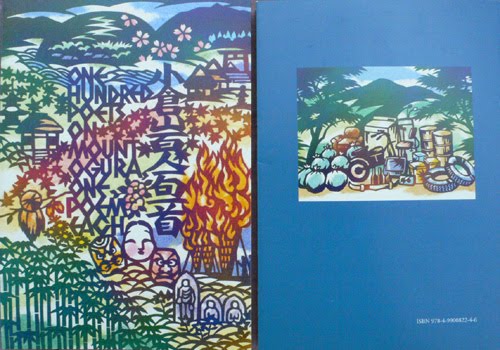
One Hundred Poets on Mount Ogura, One Poem Each

Dear Friends of Haiku,

We have a book, One Hundred Poets on Mount Ogura, One Poem Each, with much of any profit we eventually make going to charity - the charitable act of cleaning up Japan's Hill of Poetry! Our NPO needs funds for this.


The 100 contemporary poems comprise 68 haiku and 32 tanka, of which 40 were originally composed in English and 60 in Japanese. All are translated into the other language, with bilingual notes furnished about the literary history, natural history, and environmental issues to which they may allude.

Mount Ogura is situated in the Sagano area of rural Kyoto, and was where Priest Saigyo built his first hermitage, where Fujiwara Teika compiled his Hyakunin Isshu (100 classical poems collection that became the karuta card game), and where Basho wrote his Saga Nikki.

For the past six or seven years, a few of us have been taking groups of haiku poets, local people, students, resident foreigners, etc. up the mountain to clear the tons of rubbish illegally tipped there, and to help with conservation of pine and bamboo forest.

It is a gem of a hill - with views on all sides, some into a gorge - but it needs love. It took 6 years before the editors felt they had enough good poems from which to select. We are there now - the book has been launched - and I (as one of the editors) am wondering to whom to send a review copy.

The 136-page book is unique in its mix of both Japanese and English, haiku and tanka, and in its local literary/environmental thrust. We would like the poems to get a good airing and the haiku/tanka community to enjoy them - some by respected poets (a few well-known), others by locals who until the day they went to Mt. Ogura had probably never written a poem in their lives.

If you, or your journal/site editor would like a copy, ostensibly for review, please shout! If you would like to order one personally, that would be appreciated, of course, and to that end the prices are given below. We will have to see how the stock goes with our free allocation. The full-color covers by Yoshio Kawagoe (two scissor-cut works of Saga and of some rubbish cleared!) are viewable on our Icebox site at quite near the top (or on the Publications page accessed at top right).


Stephen (Tito)

Following the monk
with a key as long as a wand ...
autumn leaves


Prices for anyone wishing to order copies
Ordering from abroad: US$ cash double-wrapped inside your order and another blank sheet in an envelope to Hisashi Miyazaki, 54-16 Hamuro-cho, Takatsuki-shi, Osaka-fu 569-1147, Japan. Prices incl. p & p and have been specially discounted for foreign orders. Pounds sterling also accepted. Please do your own conversion. Hisashi is very efficient and will send you the book(s) by return. hmyzk1307@iris.eonet.ne.jp

1 copy $ 15, 2 copies $ 32, 3 copies $ 49, 4 copies $ 64, 6 copies $ 90, 8 copies $ 116, 10 copies $ 140.

If ordering within Japan, use genkin-kakitome 現金書留 available at your local post office (this cash-secure envelope costs about ¥500). Put your order letter and the exact cash necessary for your book order in the envelope and address it to Mari Kawaguchi, 6-62C-907, Senriyama-nishi, Suita-shi, Osaka-fu〒565-0851 大阪府吹田市千里山西6-62C-907河口万理様 mjk-marik@aria.ocn.ne.jp tel. 06-6821-6074. Prices incl. p & p. Mari is also a longterm member of the Hailstone Haiku Circle. Please trust her.
1 copy ¥1,690, 2 copies ¥2,840, 3 copies ¥4,140, 4 copies ¥4,950, 6 copies ¥7,050, 8 copies ¥9,190, 10 copies ¥10,690.

© JapanVisitor.com

Yahoo Japan Auction Service
Japanese Friends
Tokyo Apartments Search
Japan Job Search
Rough Guide To Japan


Tags


Thursday, August 12, 2010

Fukurokuju

福禄寿

Fukurokuju is one of the seven lucky gods called Shichifukujin, that can be seen in temples throughout Japan.


Fukurokuju originated in China and is generally depicted in the garments of ancient Chinese scholars with a long white beard. His head takes up nearly half his height and so it is no surprise that Fukurokuju is the patron deity of chess players and scientists. More surprisingly Fukurokuju is also the go-to demi-god for athletes, gardeners, jewelers, magicians and miners. Fukurokuju symbolizes wealth, happiness and longevity.


Alone among the Shichifukujin, Fukurokuju is credited with being able to raise the dead.

The images of Fukurokuju were taken at Sekizanzenin Temple in north eastern Kyoto at the foot of Mt. Hiei.

© JapanVisitor.com

Yahoo Japan Auction Service
Japanese Friends
Japan Job Search
Rough Guide To Japan
Tags