 There will be free food along with free drinks (beers, wine, cocktail drinks and juices). Map & Directions
|
Tuesday, November 16, 2010
Nagoya Friends at WINC Aichi 11/20 (THIS SAT!) 6:30-10pm


Asakusabashi Station Tokyo
浅草橋駅

The Asakusabashi (literally "Shallow Grass Bridge") station building serves two lines: the JR Sobu line, between Akihabara Station to the west, and Ryogoku Station to the east, and the Asakusa subway line between Higashi-Nihonbashi and Kuramae stations.
The station is on the north-south-running Edo-dori Avenue that intersects Yasukuni-dori Avenue just a little to the south of the station.
The JR station is on the second story of the building. It has an east and west exit, and is open between 6am and 11.30pm every day.
The Asakusa subway line station is on the underground floor and is open from around 5 am to around midnight. It has six exits: A1 to A6.

JR Asakusabashi Station began life in 1932, and the subway Asakusabashi Station in 1960.
The JR station and subway station serve about 50,000 passengers per day each, for a total of about 100,000.
The stations serve the surrounding Asakusabashi and Yanagibashi districts, well known for their numerous stores specializing in traditional Japanese dolls, as well as fireworks stores, fabric, trinket and clothing accessory stores, and even a specialty balloon store. There are several banks, convenience stores, Japanese fast food stores, a supermarket, restaurants, pachinko parlors around the station and under the elevated JR Sobu line. (NB The McDonald's still showing near the station on the Google Map has closed.)
Being in Tokyo's east end, the Asakusabashi area lacks sophistication as a shopping area, and, being small, relies for custom on residents, not visitors from other parts of Tokyo.
The only possible tourist attraction in this area is the tour boats moored in the Higashi-Kanda River, just south of the station, and that flows into the Sumida River, just east. However, most of these boats are for group hire, and are far more expensive than their size and condition warrant.

Asakusabashi station is at 1-18-11 Asakusabashi, Taito-ku, Tokyo
The JR station telephone does not have a direct telephone line for customers, but lost and forgotten inquiries can be made to the JR Lost Property Office at 050-2016-1601.
Subway station tel: 03-3866-8765
© JapanVisitor.com
Yahoo Japan Auction Service
Japanese Friends
Tokyo Apartments Search
Japan Job Search
Rough Guide To Japan
Tags
Japan
Tokyo
Asakusabashi
station
railway
subway

The Asakusabashi (literally "Shallow Grass Bridge") station building serves two lines: the JR Sobu line, between Akihabara Station to the west, and Ryogoku Station to the east, and the Asakusa subway line between Higashi-Nihonbashi and Kuramae stations.
The station is on the north-south-running Edo-dori Avenue that intersects Yasukuni-dori Avenue just a little to the south of the station.
The JR station is on the second story of the building. It has an east and west exit, and is open between 6am and 11.30pm every day.
The Asakusa subway line station is on the underground floor and is open from around 5 am to around midnight. It has six exits: A1 to A6.

JR Asakusabashi Station began life in 1932, and the subway Asakusabashi Station in 1960.
The JR station and subway station serve about 50,000 passengers per day each, for a total of about 100,000.
The stations serve the surrounding Asakusabashi and Yanagibashi districts, well known for their numerous stores specializing in traditional Japanese dolls, as well as fireworks stores, fabric, trinket and clothing accessory stores, and even a specialty balloon store. There are several banks, convenience stores, Japanese fast food stores, a supermarket, restaurants, pachinko parlors around the station and under the elevated JR Sobu line. (NB The McDonald's still showing near the station on the Google Map has closed.)
Being in Tokyo's east end, the Asakusabashi area lacks sophistication as a shopping area, and, being small, relies for custom on residents, not visitors from other parts of Tokyo.
The only possible tourist attraction in this area is the tour boats moored in the Higashi-Kanda River, just south of the station, and that flows into the Sumida River, just east. However, most of these boats are for group hire, and are far more expensive than their size and condition warrant.

Asakusabashi station is at 1-18-11 Asakusabashi, Taito-ku, Tokyo
The JR station telephone does not have a direct telephone line for customers, but lost and forgotten inquiries can be made to the JR Lost Property Office at 050-2016-1601.
Subway station tel: 03-3866-8765
© JapanVisitor.com
Yahoo Japan Auction Service
Japanese Friends
Tokyo Apartments Search
Japan Job Search
Rough Guide To Japan
Tags
Japan
Tokyo
Asakusabashi
station
railway
subway
Monday, November 15, 2010
Takachiho Station
高千穂駅
The Takachiho to Nobeoka Line in Kyushu, southern Japan was closed in 2005 following the powerful typhoon Nabi and subsequent flooding which washed away two bridges along the route. No funds were available from central government for rebuilding and the company went into liquidation in 2009.

Now Takachiho Station runs only a few toy "torokko" trains a couple of kilometers down the line for tourists. The station remains open as a travel information and tribute center to the former glories of the picturesque railway, which linked the tourist town of Takachiho to Nobeoka and from there to Oita, Fukuoka (via Kokura) and the rest of the country.

The 50km-long Takachiho Railway was one of the most scenic railways in Japan before the disaster with 14 daily trains in each direction.

Takachiho Amaterasu Rail Park
Tel: 0982 72 3216
© JapanVisitor.com
Yahoo Japan Auction Service
Japanese Friends
Tokyo Map
Japan Job Search
Rough Guide To Japan
Tags
Japan Railways
Kyushu
Nobeoka
Takachiho
Takachiho Station
The Takachiho to Nobeoka Line in Kyushu, southern Japan was closed in 2005 following the powerful typhoon Nabi and subsequent flooding which washed away two bridges along the route. No funds were available from central government for rebuilding and the company went into liquidation in 2009.
Now Takachiho Station runs only a few toy "torokko" trains a couple of kilometers down the line for tourists. The station remains open as a travel information and tribute center to the former glories of the picturesque railway, which linked the tourist town of Takachiho to Nobeoka and from there to Oita, Fukuoka (via Kokura) and the rest of the country.
The 50km-long Takachiho Railway was one of the most scenic railways in Japan before the disaster with 14 daily trains in each direction.
Takachiho Amaterasu Rail Park
Tel: 0982 72 3216
© JapanVisitor.com
Yahoo Japan Auction Service
Japanese Friends
Tokyo Map
Japan Job Search
Rough Guide To Japan
Tags
Japan Railways
Kyushu
Nobeoka
Takachiho
Takachiho Station
Sunday, November 14, 2010
APEC hits Tokyo traffic

The 18th APEC Economic Leaders’ Meeting took place in Yokohama on 13 and 14 November - just finishing last night. While attempts were being made to kick start the long-stalled Doha Development Round talks, and Prime Minister Kan reasserted the Japaneseness of the Senkaku/Diaoyu Islands, and President Obama was seeking freer trade with Asian countries, the police in Tokyo were taking no risks and restricting traffic around key areas of the meeting and the leaders' accommodation.
The result this weekend was unusually severe traffic congestion in certain parts of Tokyo, a fact that was carefully planned for and which announcements were made continually over Saturday and Sunday.
The above photo was taken on Edo-dori Avenue in Tokyo's Taito ward (one stop east of Akihabara). It says "APEC: until November 14, restrictions are in place on metropolitan freeways."
© JapanVisitor.com
Yahoo Japan Auction Service
Japanese Friends
Tokyo Apartments Search
Japan Job Search
Rough Guide To Japan
Tags
Japan
Tokyo
APEC
traffic
Saturday, November 13, 2010
Japan News this Week 14 November 2010
今週の日本
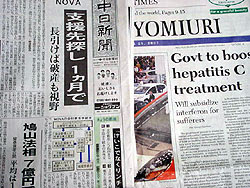 Return of the Samurai
New York Times
Japanese Runner Looks to Make Mark in New York
New York Times
Japanese Whirlwind Kagawa Propelling Borussia Dortmund in Bundesliga
New York Times
Must Japan be eclipsed by China?
BBC
Japanese bra that talks and promotes sightseeing
CNN
Can a pop opera bring Japanese animation to life?
CNN
Japanese coast guard member admits to leaking collision video
CNN
The yakuza
Guardian
Peace Prize winners meet in Japan to abolish nukes
Washington Post
日本内阁会议通过“经济合作基本方针”
Caijing
Uniting APEC too tall an order for Kan?
Japan Times
Le Japon tétanisé par ses disputes avec la Chine et la Russie
Le Monde
Japanese draw Argentina in Copa America
Yahoo Sports
Last week's Japan news
Japan Statistics
Beer consumption fell to a record low in October. Domestic shipments of beer-like budgets dropped 6.2% from the previous year, down to 35.63 million cases.
Source: Kyodo News
"Are you satisfied with your salary?"
Yes: 27%
No: 55%
Neither: 18%
Source: Asahi Shinbun Poll
© JapanVisitor
Book a hotel in Japan with Bookings
Japanese Fiction
Happi Coats
Tags
Japan News Japan Statistics politics
 Return of the Samurai
New York Times
Japanese Runner Looks to Make Mark in New York
New York Times
Japanese Whirlwind Kagawa Propelling Borussia Dortmund in Bundesliga
New York Times
Must Japan be eclipsed by China?
BBC
Japanese bra that talks and promotes sightseeing
CNN
Can a pop opera bring Japanese animation to life?
CNN
Japanese coast guard member admits to leaking collision video
CNN
The yakuza
Guardian
Peace Prize winners meet in Japan to abolish nukes
Washington Post
日本内阁会议通过“经济合作基本方针”
Caijing
Uniting APEC too tall an order for Kan?
Japan Times
Le Japon tétanisé par ses disputes avec la Chine et la Russie
Le Monde
Japanese draw Argentina in Copa America
Yahoo Sports
Last week's Japan news
Japan Statistics
Beer consumption fell to a record low in October. Domestic shipments of beer-like budgets dropped 6.2% from the previous year, down to 35.63 million cases.
Source: Kyodo News
"Are you satisfied with your salary?"
Yes: 27%
No: 55%
Neither: 18%
Source: Asahi Shinbun Poll
© JapanVisitor
Book a hotel in Japan with Bookings
Japanese Fiction
Happi Coats
Tags
Japan News Japan Statistics politics
Friday, November 12, 2010
The Monster Movie Fan’s Guide to Japan
The Monster Movie Fan’s Guide to Japan
by Armand Vaquer
51 pages
Californian Armand Vaquer is a serious kaiju eiga (monster movie) fan, especially of the monster of monsters, Godzilla. He writes for various fan blogs on the subject, he travels to fan conventions, he has met up with Godzilla personnel all to the way up to the president of Toho Pictures, and he has traveled numerous times to Japan to visit the original Godzilla settings.
"Original settings" is a bit a tricky concept in this context, of course. Those Japanese landmarks had been recreated as scale models in the Toho Studios and were then destroyed by the giant monster. In real life, they still stand unscathed by any monster action and can easily be visited.

The Monster Movie Fan's Guide to Japan is Vaquer's guide aimed at monster fans who also want to travel to Japan and see the sites where Godzilla went on his rampages.
The fanzine-style, self-published booklet starts out with a detailed description of the basics, from getting an American passport to the procedures at Narita Airport to the details of Japan Rail passes.
He then moves on to the actual cities Godzilla scenes took place in, starting with Sapporo in the north and going all the way down to Kagoshima in the south.
Tokyo has of course been most prominently featured in the movies, Yokohama, Nagoya and a few other cities have also had their share of space on the Godzilla screens. There, the most and best settings can be found and Vaquer lists a lot of them.
Vaquer's writing is at its best when he can actually relate a certain building or mountain to a certain scene in a specific movie. Unfortunately, Vaquer has always just come to Japan as a tourist on short trips. He rarely provides much detail. In most cases, he just tells the fans "This landmark was destroyed by Godzilla in XY movie" and already moves on to the next topic. But for hardcore kaiju fans who know the films by heart, this might be all they need to know.
In the case of cities that have only one or two sites connected with monster movie settings, Vaquer provides general information on what else is to see and do there. So, the reader can decide if the destination is worth a trip.
In short, if you are a real Godzilla fan and have always toyed around with the idea that someday you might go to Japan and see the home of the monster by yourself, this booklet is for you. It might help to get you started to actually realize that trip.
Distributed by Comix Press online:
Price: US$ 15 plus shipping
© Johannes Schönherr & JapanVisitor.com
Yahoo Japan Auction Service
Japanese Friends
Tokyo Apartments Search
Tokyo Map
Rough Guide To Japan
Tags
Japan movie
Godzilla
Monster Movie
Japanese magazines
by Armand Vaquer
51 pages
Californian Armand Vaquer is a serious kaiju eiga (monster movie) fan, especially of the monster of monsters, Godzilla. He writes for various fan blogs on the subject, he travels to fan conventions, he has met up with Godzilla personnel all to the way up to the president of Toho Pictures, and he has traveled numerous times to Japan to visit the original Godzilla settings.
"Original settings" is a bit a tricky concept in this context, of course. Those Japanese landmarks had been recreated as scale models in the Toho Studios and were then destroyed by the giant monster. In real life, they still stand unscathed by any monster action and can easily be visited.
The Monster Movie Fan's Guide to Japan is Vaquer's guide aimed at monster fans who also want to travel to Japan and see the sites where Godzilla went on his rampages.
The fanzine-style, self-published booklet starts out with a detailed description of the basics, from getting an American passport to the procedures at Narita Airport to the details of Japan Rail passes.
He then moves on to the actual cities Godzilla scenes took place in, starting with Sapporo in the north and going all the way down to Kagoshima in the south.
Tokyo has of course been most prominently featured in the movies, Yokohama, Nagoya and a few other cities have also had their share of space on the Godzilla screens. There, the most and best settings can be found and Vaquer lists a lot of them.
Vaquer's writing is at its best when he can actually relate a certain building or mountain to a certain scene in a specific movie. Unfortunately, Vaquer has always just come to Japan as a tourist on short trips. He rarely provides much detail. In most cases, he just tells the fans "This landmark was destroyed by Godzilla in XY movie" and already moves on to the next topic. But for hardcore kaiju fans who know the films by heart, this might be all they need to know.
In the case of cities that have only one or two sites connected with monster movie settings, Vaquer provides general information on what else is to see and do there. So, the reader can decide if the destination is worth a trip.
In short, if you are a real Godzilla fan and have always toyed around with the idea that someday you might go to Japan and see the home of the monster by yourself, this booklet is for you. It might help to get you started to actually realize that trip.
Distributed by Comix Press online:
Price: US$ 15 plus shipping
© Johannes Schönherr & JapanVisitor.com
Yahoo Japan Auction Service
Japanese Friends
Tokyo Apartments Search
Tokyo Map
Rough Guide To Japan
Tags
Japan movie
Godzilla
Monster Movie
Japanese magazines
Thursday, November 11, 2010
Nishijin Kyoto
 西陣
西陣Kyoto's Nishijin area is the city's traditional weaving section.
It has seen its fortunes wane because of the strength of the yen and lifestyle changes. Even in Kyoto, most women rarely wear kimono though yukata robes are making a bit of a comeback.
Much of the area - roughly north of Imadegawa, west of Horikawa - is defined by traditional buildings. And many weaving companies remain.
The alley pictured above right is one of the few remaining "roji" - a narrow cul-de-sac lined with wooden homes and shops.
Because of building codes, such alleys once they disappear will be gone for good. The primary reason is safety: fire trucks and equipment cannot get into the narrow alleys.
© JapanVisitor.com
Yahoo Japan Auction Service
Japanese Friends
Tokyo Apartments Search
Japan Job Search
Rough Guide To Japan
Tags
Japan
Tokyo
Kyoto
Nishijin
Japanese
Subscribe to:
Posts (Atom)